
Women's Health's beginner plan: 4 weeks, 20 to 45 minutes
A four-week beginner plan of full-body strength sessions, optional cardio and scheduled rest days, 20 to 45 minutes at a time. The equipment list is shorter than it looks.
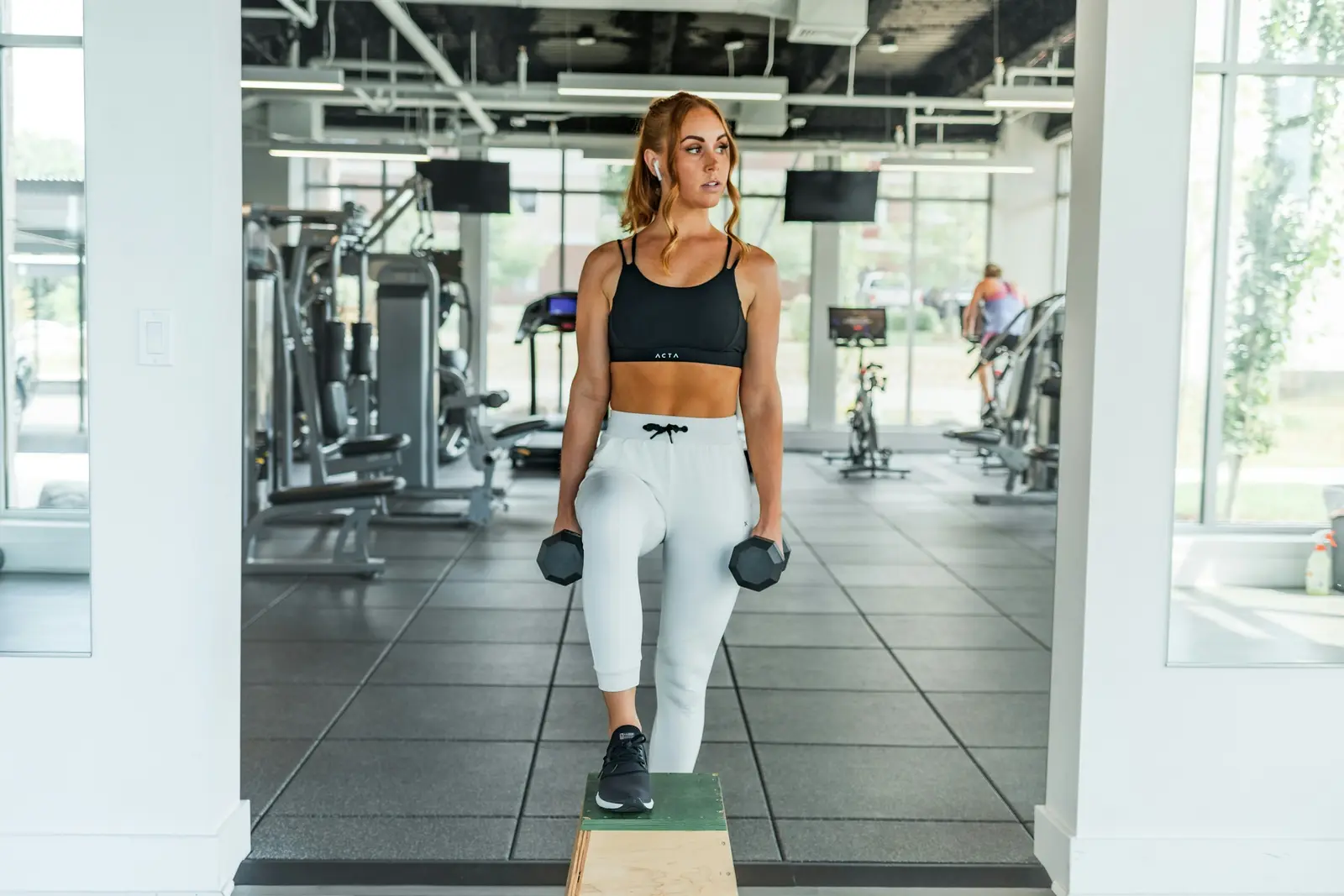
The Women's Health beginner workout plan is a four-week program: full-body strength sessions, optional cardio, active recovery and rest days, with each workout running 20 to 45 minutes. It's a downloadable PDF tied to the magazine's WH+ membership, and the coach is Kristen McParland, CPT. You need dumbbells, a kettlebell, a step or box and a slam ball, and dumbbells can stand in for the kettlebell and the ball.
Four weeks won't build much visible muscle. The job of a first program is to teach the movement patterns, get you through the soreness that arrives in week one, and leave you with a routine you can repeat with heavier weights in month two.
What the four weeks contain
The plan assigns a day type to each day rather than leaving you to decide at the gym door. Strength days train the whole body each time; there's no body-part split. Every strength session opens with a warm-up and closes with a cooldown, and the same two routines work on cardio days, which saves you from building a second routine you'll never use.
- Strength day: a full-body session, 20 to 45 minutes, warm-up and cooldown included.
- Optional cardio: steady work you can skip without breaking the program.
- Active recovery: movement light enough that you finish fresher than you started.
- Rest: a day off that's on the schedule, not a day you ran out of time.
The PDF has an exercise guide with instructions for each movement. For a beginner that section does real work, because the difference between a hip hinge and a squat isn't obvious from a name in a list, and a hinge done as a squat is how lower backs get angry in week one.
The equipment list, and what you can skip
Dumbbells, a kettlebell, a step or box and a slam ball. The plan's own note says the kettlebell and slam ball exercises can be done with a dumbbell, so a pair of adjustable dumbbells and something sturdy to step onto cover nearly all of it. Buy the dumbbells first. A slam ball is the item you'll use least and the one that costs the most per minute of use.
If you're training at home and the budget is tight, adjustable dumbbells are the purchase that keeps working past week four, because the whole progression depends on being able to go heavier.
A sample week built on the plan's structure
The sets and reps sit inside the PDF; the public page doesn't list them. Below is the plan's structure filled in with standard beginner prescriptions, so you can see what four weeks of it looks like and run the shape while you decide whether to buy it.
Week 1: learn the pattern, two sets each
Full body A
- Goblet squat2 sets · 8 · Pick a weight you could do 3 more reps with. Same weight all week.
- Dumbbell floor press2 sets · 8 · Elbows at 45 degrees. Same weight all week.
- One-arm dumbbell row2 sets · 8 per side · Brace a hand on a bench or chair. No jerking.
- Plank2 sets · 20 seconds · Add 5 seconds each week until you reach 45.
Full body B
- Dumbbell Romanian deadlift2 sets · 8 · Push hips back, stop when hamstrings tighten.
- Dumbbell overhead press2 sets · 8 · Seated is fine if standing feels wobbly.
- Step-up2 sets · 8 per leg · Use a box you can step onto without leaning.
- Farmer carry2 sets · 30 seconds · Walk tall, add 10 seconds next week.
Optional cardio
- Incline walk or easy bike1 sets · 20 minutes · Conversational pace. You should be able to talk.
- Hip and ankle mobility2 sets · 5 slow reps each · Same routine on every cardio day.
Week 2: add a set, keep the weight
Full body A
- Goblet squat3 sets · 8 · Third set at the same weight as the first two.
- Dumbbell floor press3 sets · 8 · Rest 90 seconds between sets.
- One-arm dumbbell row3 sets · 8 per side · Same weight as week 1.
- Plank2 sets · 25 seconds · Stop the set when your hips drop.
Full body B
- Dumbbell Romanian deadlift3 sets · 8 · Same weight as week 1 unless form broke down.
- Dumbbell overhead press3 sets · 8 · Stop two reps short of a grind.
- Step-up3 sets · 8 per leg · Same box height all week.
- Farmer carry2 sets · 40 seconds · Same dumbbells, longer walk.
Optional cardio
- Incline walk or easy bike1 sets · 25 minutes · Keep the pace conversational.
- Hip and ankle mobility2 sets · 5 slow reps each · Unchanged.
Week 3: add reps before you add weight
Full body A
- Goblet squat3 sets · 10 · Same weight, two more reps per set.
- Dumbbell floor press3 sets · 10 · Same weight, two more reps per set.
- One-arm dumbbell row3 sets · 10 per side · Last two reps should be work, not a struggle.
- Plank2 sets · 35 seconds · Add 5 seconds if week 2 felt easy.
Full body B
- Dumbbell Romanian deadlift3 sets · 10 · Same weight, slower down phase.
- Dumbbell overhead press3 sets · 10 · If you can't get 10, stay at 8 and add weight instead.
- Step-up3 sets · 10 per leg · Same box, more reps.
- Farmer carry2 sets · 45 seconds · Grip should be the limiting factor.
Optional cardio
- Incline walk or easy bike1 sets · 30 minutes · Add time, not speed.
- Hip and ankle mobility2 sets · 5 slow reps each · Unchanged.
Week 4: hit 12 reps, then go heavier next month
Full body A
- Goblet squat3 sets · 12 · If 12 is clean, start month two with the next dumbbell up at 8 reps.
- Dumbbell floor press3 sets · 12 · Same rule: heavier next month, back to 8 reps.
- One-arm dumbbell row3 sets · 12 per side · Heavier next month at 8 reps.
- Plank2 sets · 45 seconds · Once 45 is easy, add a set.
Full body B
- Dumbbell Romanian deadlift3 sets · 12 · Heavier next month, 8 reps, same form.
- Dumbbell overhead press3 sets · 12 · Heavier next month, 8 reps.
- Step-up3 sets · 12 per leg · Raise the box before you add weight.
- Farmer carry3 sets · 45 seconds · Heavier dumbbells, keep the walk tall.
Optional cardio
- Incline walk or easy bike1 sets · 30 minutes · Keep it at 30 and hold the pace.
- Hip and ankle mobility2 sets · 5 slow reps each · Carry it into month two.
How to pick the weight
Choose a dumbbell you could lift for three more reps than the set asks for. That feels too light in week one, and it's the correct choice, because the first week is where you learn the movement and the second week is where the soreness lands. If the last rep of the last set slows down noticeably, the weight is right. If you can't finish the set with clean form, drop down a pair and finish the set.
Progressive overload across four weeks
Two things move: sets and reps. Go from two sets to three in week two, add reps in weeks three and four, then add weight at the start of the next cycle and drop back to eight. That's the whole progression, and it's enough for a first month. You don't need a deload, a tempo block or an app to track it. A note on your phone with the weight and reps for each lift does the job.
Volume stays modest by design. Two or three sets per exercise, two or three lifting sessions a week, adds strength in the first couple of months; extra sets mostly add soreness and missed sessions. The number that matters most in month one is how many workouts you completed.
Cardio is optional, and the plan has a reason
Cardio here isn't a fat-loss add-on to cancel out dinner. Two easy sessions of 20 to 30 minutes a week help you recover between sets and handle the third lifting day without feeling wrecked. Walking on an incline or easy cycling is plenty. If you're training for a race, this isn't the plan; find one with scheduled runs, because two optional cardio days won't get you to a start line.
What McParland says it does, and how solid that is
McParland's list: building muscle increases total-body strength, bones, ligaments and tendons get healthier, and blood pressure and immunity may improve. Those four claims aren't equally well supported.
Strength comes fastest and most reliably, and beginners notice it within three or four weeks. Bone density responds to loaded training too, but slowly, over years, and the effect is modest. Tendons and ligaments do adapt to resistance work and get better at handling load, though the evidence in new lifters is thinner than it is for muscle. Blood pressure drops by a few points on average with regular exercise, which is worth something if yours runs high and not much if it doesn't. Immunity is the weakest of the four: the evidence is thin, the effect is small, and I wouldn't choose a program for it.
What four weeks will and won't do
Expect better coordination on the main lifts, a slightly higher number on the dumbbells, and clothes fitting a little differently around the shoulders and legs. Visible muscle takes closer to eight to twelve weeks of consistent training. The scale may go up a pound or two in the first fortnight from water and glycogen, which is not fat and not a reason to add cardio.
Where beginners fall off in week two
The first mistake is going heavier than the plan says because week one felt easy. The second is skipping the warm-up when you're short on time, which is backwards: the warm-up is the part that keeps the session worth doing. The third is adding days. The rest days are in the schedule on purpose, and replacing both of them with cardio in week one shows up as a skipped lifting day in week two.
The fourth is program shopping. Four weeks tells you whether something works only if you run the four weeks. If you're reading a different plan by day ten, the plan wasn't the problem.
Who should pick a different plan
If you don't want to buy dumbbells, start with a bodyweight plan for a month; this one assumes you can add load. If a joint is already painful, get it assessed before starting a program built on squats, step-ups and hinges; that's a conversation for a physio or your doctor, not a training plan. And if you want to lift four or five days a week, you'll be bolting sessions onto a program written for two or three.
Questions people ask before starting
- How long is the Women's Health beginner workout plan?
- Four weeks. Sessions run 20 to 45 minutes, and the schedule mixes full-body strength days, optional cardio, active recovery and rest. After week four the sensible move is to repeat it with heavier dumbbells rather than jumping to an intermediate program.
- Do I need a kettlebell and slam ball to follow it?
- No. The plan says the kettlebell and slam ball exercises can be done with a dumbbell instead. A pair of adjustable dumbbells and a stable step or box cover almost everything, and they're the two items worth buying first.
- How much does the plan cost?
- The public page doesn't list a standalone price. The plan is a PDF tied to the Women's Health+ membership, so the cost is whatever that subscription costs where you live. Check the membership page before you count on a one-off purchase.
- Is it suitable for a complete beginner?
- Yes, if you can get the equipment and you're injury-free. The volume is low, every strength day has a warm-up and cooldown, and the PDF includes instructions for each exercise. A total beginner should spend week one on form with light dumbbells.
- What should I do after the four weeks?
- Run it again with the next dumbbell size up and start back at two or three sets of eight. Once you've done that twice and the last set still feels comfortable, move to a program with more volume or a barbell.
Sources
Related guides
Beginner gym workout plan: why 3 days a week beats 5 days
Three full-body sessions a week for four weeks, 2 to 3 sets of 8 to 12 reps, and a written rule for adding weight. The plan is built for a first month or a return after a year off.

Robert Strauss's over-40 workout: 45 seconds on, 15 off
Robert Strauss, 43, trains in 45-minute F45 classes: a 7-minute warmup, then three rounds of 45 seconds on and 15 off. What the format does well, and where it falls short.
Upper lower split benefits: why 4 days beats 6 for most lifters
An upper lower split trains every muscle twice a week and gives each one more hard sets than full body. Here is the four-day template, the set targets, and who should skip it.