
Banded chin-ups: 3 sets a week to your first bodyweight rep
Banded chin-ups let you train the full chin-up with part of your bodyweight taken off by a band. Here's how to pick the band, program it, and build to your first unassisted rep.
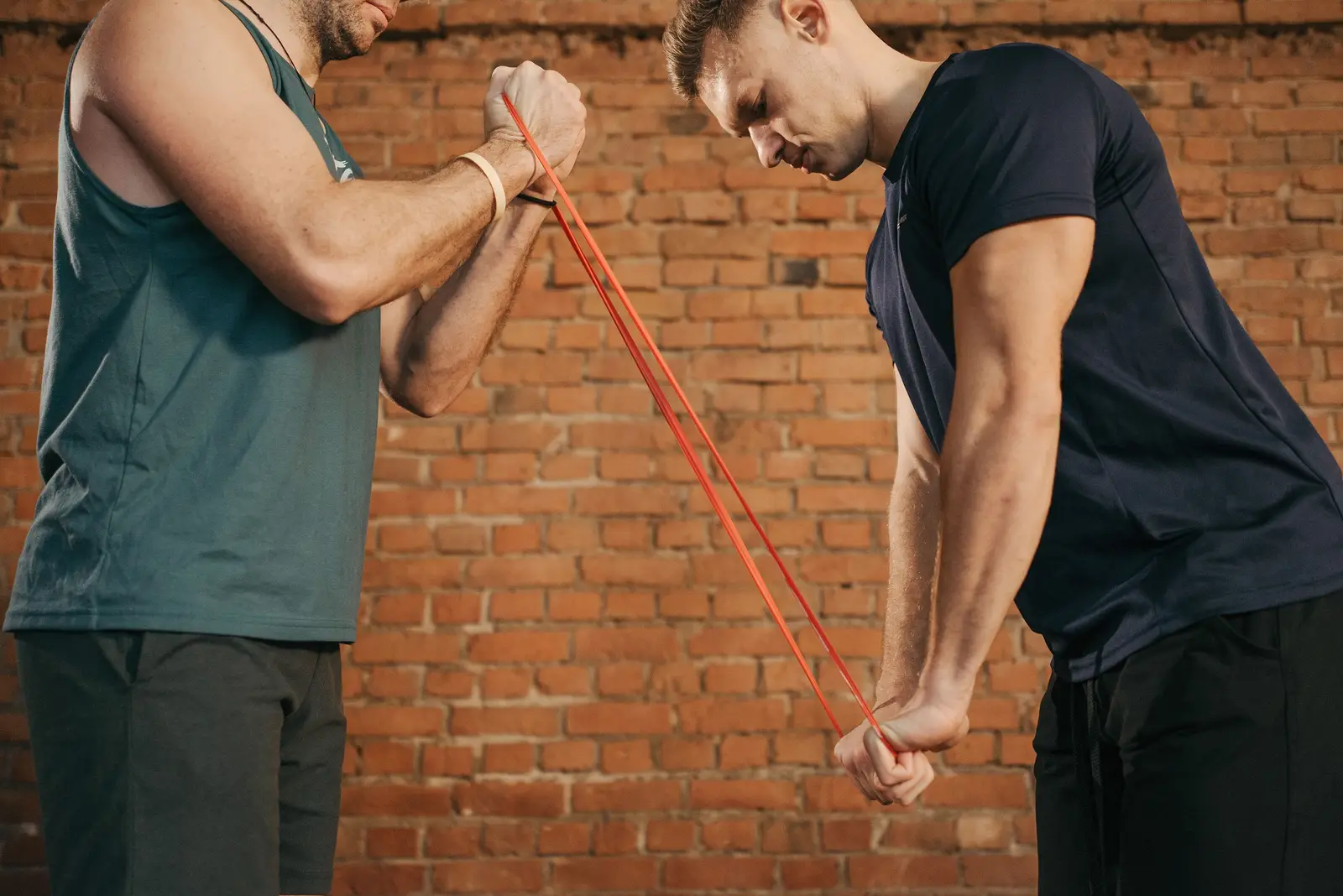
Banded chin-ups let you train the chin-up movement before you can do one at bodyweight. You loop a resistance band over a pull-up bar, put a knee or a foot in the loop, and the band takes off part of your weight so you can complete full reps with your palms facing you. That underhand grip is the difference between a chin-up and a pull-up, and it puts more of the work on your biceps.
The exercise is compound. It loads the latissimus dorsi across your back, the biceps, and the trapezius between your shoulder blades, so a single set covers a lot of upper body. You get a stretch at the bottom, a hard finish at the top, and your core works the whole time to stop your body from swinging.
What the band is actually doing
A band is an assistance dial. A thicker band carries more of your bodyweight and makes the rep easier, a thinner band carries less. The help isn't even across the range: a band is stretched furthest at the bottom of the rep, so it assists most when your arms are straight and least as your chest reaches the bar. That's why the top third of a banded chin-up still feels like a real chin-up, and why a thinner band shows up first at the bottom of the movement.
Pros
- Trains the same pattern and muscles as a bodyweight chin-up, just with less load
- Load is adjustable by swapping bands instead of adding plates
- One band and a bar cover it, so it works with very little equipment
- Full range reps are possible before you can do one unassisted rep
Cons
- Bands wear, and a torn band at chin height is a real risk
- Assistance fades near the top, so the hardest part stays hard
- Brands don't standardise tension, which makes progress hard to measure
- Easy to coast on a band that's too thick and stop progressing
How to do a banded chin-up
- Loop the band over a fixed bar that's rated for your weight plus band tension, and check the band for nicks or thinning before you hang on it.
- Put one knee or one foot into the loop. Both feet in the band gives you a lot of help and usually isn't needed.
- Take an underhand grip with palms facing you, hands roughly shoulder width, arms fully straight.
- Pull your chest toward the bar by driving your elbows down, keeping your ribs down and your core tight. No kicking, no swinging.
- Hold for a second at the top, chin near or over the bar.
- Lower with control all the way to straight arms.
Pick the band by your rep count
Brands don't agree on colour coding, and a medium from one company can feel like a light from another. Count reps instead. Pick the band that lets you do 4 to 8 clean reps with about two reps in reserve. Fewer than 4 and you need a thicker band. Ten or more and you need a thinner one. A set where you barely move is a set you can't repeat next week.
Getting to your first unassisted rep
Three things move you forward once banded reps are comfortable: thinner bands, isometric holds and slow negatives. The isometric hold means starting with your chin above the bar and holding that position for time, which teaches the top of the rep without assistance. Negatives mean starting at the top and lowering for 5 seconds. Both are short, both are humbling.
- Banded chin-ups with a thick band, 4 sets of 5 to 8 reps.
- Banded chin-ups with a thin band, 3 to 5 sets of 3 to 5 reps.
- Top holds for 15 to 20 seconds and negatives lowered over 5 seconds.
- One unassisted rep, then add a rep every week or two.
An 8-week banded chin-up plan
Two chin-up sessions a week, spaced at least two days apart, done first in the session while you're fresh. The banded reps do the strength work; the rows and pull-aparts add back volume without hammering the same elbow flexors every set. If your elbows or shoulders start complaining, drop the negatives first and keep the banded reps.
Weeks 1 to 2: thick band, full range
Session A
- Banded chin-up4 sets · 5 · Add one rep per set once all four sets leave two reps in reserve.
- Banded top hold3 sets · 15 seconds · Add 5 seconds per week, chin over the bar.
- Single-arm dumbbell row3 sets · 10 per side · Add 2 kg when you hit 12 clean reps per side.
Session B
- Banded chin-up4 sets · 5 · Same band as Session A; stop two reps short of failure.
- Inverted row3 sets · 8 · Lower the bar an inch each week.
- Band pull-apart2 sets · 15 · Move to a thicker band when 20 reps feel easy.
Weeks 3 to 5: thinner band, fewer reps
Session A
- Banded chin-up (thinner band)4 sets · 4 · Go back to the thicker band for the session if you can't get 3 clean reps.
- Banded top hold3 sets · 20 seconds · Add 5 seconds before you add a set.
- Single-arm dumbbell row3 sets · 8 per side · Add weight when every set is controlled.
Session B
- Banded chin-up5 sets · 3 · Drop to a thinner band once 5 sets of 3 feel controlled.
- Negative chin-up3 sets · 3 · Start at the top and lower for 5 seconds.
- Face pull3 sets · 12 · Add a set before adding weight.
Weeks 6 to 8: singles and volume
Session A
- Unassisted chin-up5 sets · 1 · If you miss a rep, finish the set on the band.
- Banded chin-up3 sets · 5 · Thin band, two reps in reserve, for volume after the singles.
Session B
- Negative chin-up4 sets · 3 · Lower for 5 to 8 seconds, no dropping at the bottom.
- Banded chin-up3 sets · 6 · Thin band; move to 8 reps before testing a second unassisted rep.
Move to the next phase when you hit the top of every rep range with two reps in reserve. If you stall on the same band for two sessions, add a set rather than dropping to a thicker band, and check that you're eating and sleeping enough to recover between sessions.
Form mistakes that stall progress
- Kicking or swinging to get your chin over the bar. That's momentum doing the work your lats should be doing.
- Stopping short at the bottom, where straight arms give you the most band assistance and the best stretch.
- Living on a band that's too thick. Twelve easy reps trains endurance, not strength.
- Taking every set to failure, which leaves you too sore for the second session of the week.
Who should skip banded chin-ups
If hanging from a bar hurts your shoulder, elbow or wrist, get it checked before you build a program around it. Anyone with a previous shoulder dislocation, rotator cuff problem or elbow tendinopathy should clear chin-ups with a doctor or physio, since the hanging position is demanding at any band thickness. Check your doorframe bar against its weight rating, inspect the band for tears before every session, and only anchor it to something rated for a pull.
What Rosie Huntington-Whiteley's clip shows
The model posted a clip of banded chin-ups days before returning to the Victoria's Secret runway after a 16-year break, captioned 'No days off'. She told Vogue that consistency is what carries her training, calling herself a gym girl who is always training, and has said strength work improved her posture and definition. The exercise choice makes sense: chin-ups load the upper back and biceps in one movement, and the band makes the load adjustable on a week when she wanted to keep the movement in without grinding out bodyweight reps.
Take the habit and leave the expectation. Genetics play a large part in body shape, height and how easily someone builds muscle or stays lean, so a model's training clip isn't a template for what your back will look like after eight weeks. The rep scheme is the part you can actually copy.
Frequently asked questions
- Are banded chin-ups effective for upper body strength?
- Yes, if the band leaves you 4 to 8 hard reps. You're training the same muscles through the same range as a bodyweight chin-up with less load. Once you can do 8 or more clean unassisted reps, the band stops adding much and you should train without it or add weight.
- What's the difference between a chin-up and a pull-up?
- The grip. Chin-ups use an underhand grip with palms facing you, pull-ups use an overhand grip with palms facing away. The underhand position puts the biceps in a stronger line of pull, and most people find chin-ups easier for that reason.
- How often should I do banded chin-ups?
- Two or three sessions a week, 3 to 4 sets of 4 to 8 reps. Start with two sessions and add a third when you're recovering well between them. Leave one or two reps in reserve on most sets and save the hard efforts for a single set per session.
- Which band should a beginner start with?
- The one that lets you do 5 clean reps with a rep or two left. For most first-timers that's the thickest band in the set. Colours vary by brand, so test by rep count rather than by what the label says.
- How long until I can do an unassisted chin-up?
- Eight weeks of twice-weekly practice gets a lot of people their first rep, and some need three or four months. You're close when you can hold your chin above the bar for 20 seconds and lower for 5 seconds with control.
- Can I do banded chin-ups at home?
- Only on a bar that's properly mounted and rated for your weight plus the band's tension. Doorframe bars have limits, and band tension adds force you can't see. Read the rating before you hang, and never attach a band to a door, branch or beam that isn't rated for it.
Sources
Related guides
Beginner gym workout plan: why 3 days a week beats 5 days
Three full-body sessions a week for four weeks, 2 to 3 sets of 8 to 12 reps, and a written rule for adding weight. The plan is built for a first month or a return after a year off.

Robert Strauss's over-40 workout: 45 seconds on, 15 off
Robert Strauss, 43, trains in 45-minute F45 classes: a 7-minute warmup, then three rounds of 45 seconds on and 15 off. What the format does well, and where it falls short.
Women's Health's beginner plan: 4 weeks, 20 to 45 minutes
A four-week beginner plan of full-body strength sessions, optional cardio and scheduled rest days, 20 to 45 minutes at a time. The equipment list is shorter than it looks.