
Strength machines vs free weights: what actually builds muscle
Free weights let you add load in small steps and train the stability machines skip. Machines let you push sets close to failure without a spotter. Most lifters should use both, in that order.
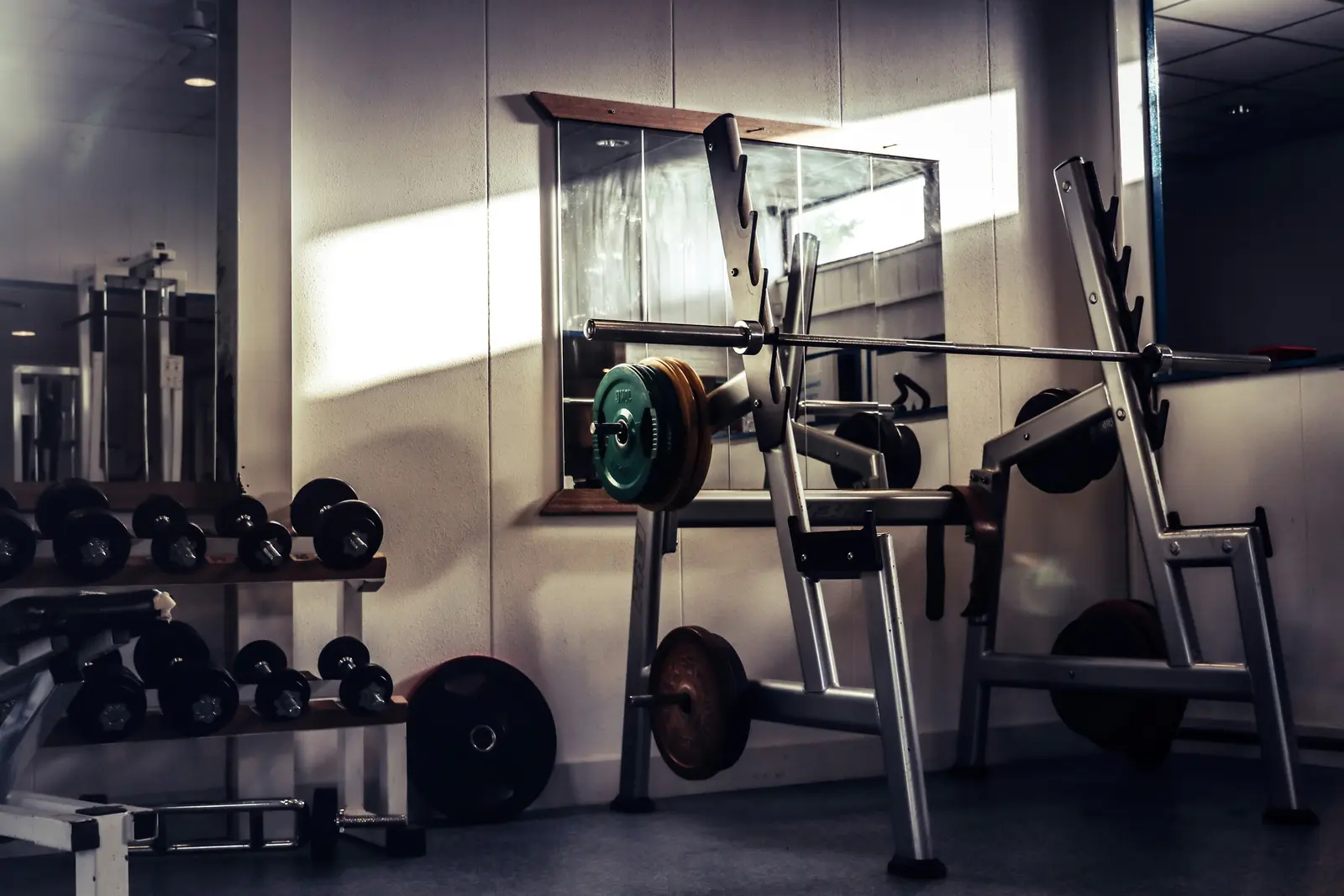
Strength machines and free weights both build muscle, and the gap between them is narrower than most gym-floor arguments suggest. Free weights still make the better foundation for most people: they load in small steps and you have to control the bar or dumbbell yourself. Modern machines are good enough that handing them a large share of your sets costs you very little, and for some joints they're the better pick.
What the comparison comes down to
Muscle grows in response to tension, effort and recovery. A machine chest press taken to two reps short of failure delivers that stimulus the same way a barbell bench press does. What changes between the two is the stability demand, the size of the loading steps, the range of motion you're allowed, and how much setup stands between you and the first rep.
I haven't seen a convincing case that machines build less muscle than free weights when the sets are equally hard. Where the two clearly part ways is strength on a specific lift, and the skill of moving a load through space under your own control. If your goal is a bigger squat, you have to squat.
Where free weights still have the edge
A barbell takes plates in 1.25 kg or 2.5 kg jumps, and most dumbbell racks step up in 2.5 to 5 pound increments, which Muscle & Fitness points out makes progress easy to track. Pin stacks on machines often jump 10 pounds or more, and the actual resistance shifts as the lever arm moves, so one more plate isn't always a clean step. Small, repeatable jumps are how you keep adding weight for months instead of weeks.
Free weights also load the prime movers and the stabilizers together. Your rotator cuff works during a dumbbell press in a way it doesn't on a guided path. Matt Wenning of Wenning Strength told Muscle & Fitness that free weights "should always remain the foundation" because they build strength, coordination and stability that machines can't fully replicate. More stabilization doesn't automatically mean more growth. It does mean more carryover to everything you do off the machine.
Fixed arcs are the other issue. Plenty of machines lock you into a path that suits some bodies and not others. If the pad position pushes your shoulder or knee into a range that hurts, you'll shorten the rep without noticing and get less from the set. A dumbbell lets you find your own path.
Where machines are the better tool
Well-equipped gyms now carry Pendulum squats, converging chest presses and row machines with independent arms. These designs use resistance curves that get harder where you're strongest, plus adjustable paths that fit more lifters. That engineering buys three practical things.
- Sets close to failure without a spotter. You can push a chest press or leg press to real effort and simply stop, with no safety pins to set and no risk of getting pinned.
- Isolation once the compound work is done. Preacher curl, leg extension and lateral raise machines let you keep loading a muscle that has already given what it has on the big lifts.
- Less setup. No rack to find, no plates to strip. On a busy evening that's the difference between finishing the session and cutting it short.
Machines also keep people training legs. If a barbell back squat aggravates your lower back, a Pendulum squat or a leg press lets you load the quads hard without the axial compression. For someone whose back limits their squatting, that's the only heavy quad work they'll get all week. If a joint hurts through a range of motion rather than just feeling loaded, get it looked at by a physio before you build a program around it.
How to split your sets
Do the free-weight lifts you care about first, while you're fresh, then use machines for the rest of the volume. That order protects technique on the lifts that need it and puts fatigue where it costs least.
Around 60 to 70 percent of your working sets on free weights is a reasonable default. Shift the balance toward machines if you're coming back from an injury, if a joint won't tolerate a barbell position, or if your main goal is size and you'd rather not spend the session on technique. If you're training for a powerlifting total, most sets belong on the competition lifts and their close variations.
One rule matters more than the split: every set has to be hard enough to count. A machine set taken to two reps short of failure does more than a barbell set you cut short because the setup was annoying.
A two-week template that uses both
Week 1: find your loads
Lower
- Back squat3 sets · 5-6 · Stop two reps short of failure and write the load down.
- Romanian deadlift3 sets · 8 · Same load both weeks if your hamstrings are still sore.
- Pendulum squat or leg press3 sets · 10-12 · Take the last set to two reps short of failure.
- Leg curl machine3 sets · 12-15 · Keep reps strict; the set ends when your hips lift.
- Standing calf raise3 sets · 12-15 · Pause one second at the bottom of every rep.
Upper
- Barbell bench press3 sets · 5-6 · Leave one clean rep in reserve.
- Chest-supported row3 sets · 8-10 · Pull to the same spot on every rep.
- Converging chest press machine3 sets · 10-12 · Push the last set to two reps short of failure.
- Lat pulldown3 sets · 10-12 · No leaning back to move the stack.
- Dumbbell lateral raise3 sets · 12-15 · Light weight, full range, no swing.
Week 2: add load
Lower
- Back squat3 sets · 5-6 · Add 2.5 kg to last week's load and hold the reps.
- Romanian deadlift3 sets · 8 · Add 2.5 kg if week 1 felt controlled.
- Pendulum squat or leg press3 sets · 10-12 · One extra plate, or one extra rep per set.
- Leg curl machine3 sets · 12-15 · Smallest stack increase available.
- Standing calf raise3 sets · 12-15 · Add reps before adding load.
Upper
- Barbell bench press3 sets · 5-6 · Add 2.5 kg and keep the same rep target.
- Chest-supported row3 sets · 8-10 · Add 2.5 kg, or two reps total across the sets.
- Converging chest press machine3 sets · 10-12 · Add the smallest increment and stay near failure.
- Lat pulldown3 sets · 10-12 · Add one rep per set before adding load.
- Dumbbell lateral raise3 sets · 12-15 · Move up to the next dumbbell only when all sets hit 15.
Run those two weeks, then repeat the pattern with the loads you finished on. If a lift stalls for three sessions in a row, drop the load 10 percent and build back up.
FAQ
- Are machines worse than free weights for building muscle?
- No, provided the sets are equally hard. Machines cut the stability demand and the setup cost, which often means you actually get close to failure. Free weights add coordination and carryover to strength on the lift itself. Your muscle responds to tension and effort; the loading steps and the skill demand are what really differ.
- Can I build muscle using only machines?
- Yes. A machine-only program with progressive loading and enough protein will build muscle. You give up some stability work and some transfer to barbell lifts. If you train alone, work out at home, or have joints that dislike free weights, machines are a sensible long-term choice.
- Is a Smith machine a free weight?
- No. The bar runs on fixed guides, so the machine handles balance for you. It sits between the two categories: more guided than a barbell, less fixed than a pin-loaded machine. It's useful for pushing close to failure on your own, but it won't train stability the way a free barbell does.
- How heavy should I go on machines compared with free weights?
- Expect more weight on the machine for the same muscle, because you aren't spending effort on balance. Judge the set by how close to failure it is, not by the number on the stack. Two reps short of failure is the target for most working sets either way.
Sources
Related guides
Strength training vs muscle size: what matters after 70
Muscle size and strength are separate adaptations, and the longevity case leans on strength. Here's how a 78-year-old reached a 132 lb deadlift, and how to split your own training.
Barbell curls hurt your wrists? 5 swaps that still build
A straight bar forces both wrists into one angle. Here are five curl variations that train the biceps just as hard, plus how to load them and when wrist pain needs a professional.
Six weighted ab exercises that beat a thousand crunches
Loaded hollow holds, cable crunches and four more weighted ab exercises, with the sets, reps and weekly loading scheme that actually builds core strength.